
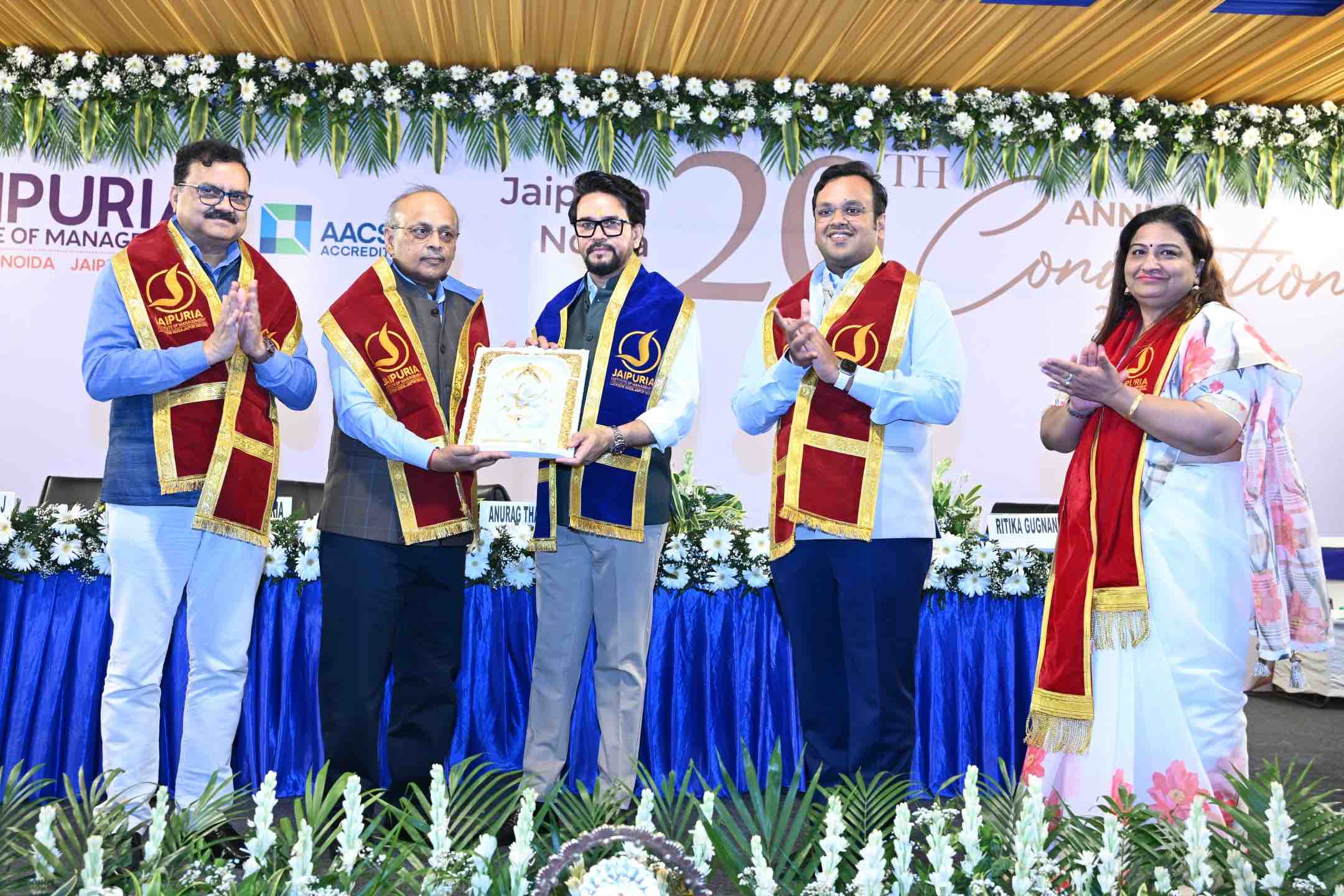

Greetings & a tribute to Jaipuria
Respected Shri Sharad Jaipuria ji, Shri Shrivats Jaipuria ji, Dr. Prabhat Pankaj ji, esteemed faculty, proud parents and my dear young students who are graduating today. My heartfelt congratulations to each and every one of you.
I know two generations of the Jaipuria family. Sharad ji and I go back a long way, and no one knows better than them how to keep doing business well in difficult circumstances, and how to keep a smile on your face no matter what the situation.
Before arriving, I was reading about Jaipuria, and the more I read, the more I was impressed. Eighty years since 1945. Before India was even free from the British, the Jaipuria family chose not to invest in factories or stock markets, but in the most valuable asset a nation can possess: human minds. That is not ambition. That is vision.
Today, Jaipuria Institute of Management stands AACSB accredited, a distinction earned by only 6% of business schools in the entire world, and barely 3% in India. Graduates here today, you did not just receive a degree from a good college. You graduated from an institution that holds its own against the finest management schools on this planet. Jaipuria Noida is ranked 41st in NIRF and steadily climbing, and what strikes me more than the rankings is this: nearly 50% of Jaipuria alumni reach a General Manager or equivalent position within ten years of graduating. That is the real metric of institutional greatness. Not what you get on day one, but what you become over a decade.
Jaipuria has the philosophy of being 'Student First'. In public life, the party I belong to (the Bharatiya Janata Party) has the parallel philosophy of 'Nation First'. When these two ideas combine in the minds of this graduating class, they can be transformative. And one more thing. Jaipuria calls itself the first AI-native business school. You are the generation that will not be disrupted by artificial intelligence, because you were trained to harness it.
Reform, Perform, Transform
Let me take you through the journey of Reform, Perform and Transform. As Dr. APJ Abdul Kalam once said, 'A nation's strength ultimately consists in what it can do on its own.' That is the spirit that has driven the reform agenda since 2014.
GST: One Nation, One Tax. In July 2017, India unified 17 major indirect taxes and over 23 cesses into a single Goods and Services Tax, something that had been debated for two decades. Today monthly GST collections regularly cross ₹1.7–1.9 lakh crore, and in April 2026 collections hit an all-time high of ₹2.43 lakh crore. This is not just tax reform. It is civilisational integration of the Indian economy.
The Insolvency and Bankruptcy Code, 2016 transformed how India handles financial stress. Over ₹3.5 lakh crore has been recovered through the IBC process, money that would have otherwise stayed trapped. RERA brought real estate, one of India's most opaque sectors, under regulatory oversight. Millions of home buyers finally had legal recourse.
Banking sector reforms. In 2014, 11 of 12 public sector banks were under the PCA framework. After the 4R reforms, 12 out of 12 PSBs are out of PCA and together making record profits of nearly ₹2 lakh crore annually. On Ease of Doing Business, India has moved from rank 142 in 2014 to around 63 today.
Performance — the numbers speak
Reforms only matter if they deliver, and the performance numbers speak for themselves. In 2014 India was among the 'Fragile Five' economies. In just 12 years, India is the fifth largest economy in the world, and in the next few years, India is bound to be the third largest.
I still remember in Parliament a former Finance Minister saying: 'Indian villages don't have internet, they don't have smartphones, who will make digital payments?' Let me ask each of you. How many of you make digital payments? Today UPI has become the way India transacts, from metros to the smallest village.
The fire to do something for the country must burn within you. If we have to build Viksit Bharat by 2047, the next 18–20 years are for the nation. Don't just build a career. Take this country forward.
Capacity, COVID and civic sense
We saw it during COVID. India did not have PPE manufacturing. Very few units made even masks, let alone vaccines. But we built our capacity. India not only built vaccines for itself. Under our vaccine programme we supplied vaccines to more than 150 countries. That is no small thing. You will face that kind of challenge in the future too.
Cleanliness is one of the most important things. If everyone fulfils their responsibility. If you ever go to Tokyo, you will not find a single dustbin on the streets of a city of more than four crore people. Whoever drinks tea or coffee carries the cup in their pocket until they find a bin. When the Japanese football team lost to Russia in the 2018 World Cup, their fans cleaned the stands. The team cleaned its own dressing room and left a note: 'All the best to the next team.' They lost the match, but they won everyone's heart. Civic sense is built by society, not government. When we start small efforts on our part, society changes.
Five things I genuinely believe in
Let me end not as a Member of Parliament or as a former Union Minister, but as one of you, as a Bharatiya. I want to tell you five things I genuinely believe in.
One. Choose Bharat first. The greatest temptation for bright management graduates is an offer abroad. I will not pretend it isn't tempting. But there has never been a better time in history to build your career in India, for India. India is not a developing economy waiting to grow. India is growing right now, in front of your eyes. The companies, brands, institutions and the policy of Viksit Bharat will be built by the people in this room today. Ask yourself. Do you want to be part of a story that has already been written, or help write a story the world will read for the next hundred years?
Two. Be the entrepreneur, not just the employee. India needs job creators, not job seekers. We have built the infrastructure: Startup India, Fund of Funds, SIDBI, Mudra, PLI. We are the fastest in India's history to process startup registrations and regulatory approvals. Management education gives you the tools. But the tools are only useful if you pick them up. I challenge at least a few of you, not all, not even most, to start something. A company, a social enterprise, a product that solves a real Indian problem. The world does not need another manager who manages. India needs builders. As Dhirubhai Ambani said, 'Dream big, dare to fail.'
Three. Lead with ethics, because India is watching. You are graduating from an AACSB accredited institution. You carry a brand that stands for something, and with that brand comes responsibility. In my years in public life I have seen that the biggest deficit in Indian public and corporate life is not capital, not technology, not talent. It is trust. Ethical leadership is not a soft skill. In the India of 2026 it is the scarcest and the most valuable competency of all. When you take your first job, start your first venture, lead your first team. Lead with integrity. Pay your taxes. Treat your employees fairly. Reject corruption at every level. The India we want to build cannot be built on shortcuts. It will be built on character.
Four. Use technology to solve hard problems. India and Bharat are not the same. Many of you here are from big cities or tier-2 and tier-3 towns. You may be ordering on Zomato or Blinkit, living in AC rooms. But the majority of India lives in villages, semi-urban areas and small towns. That is a huge market many entrepreneurs still ignore. You have been trained as AI-native managers. You understand technology. You understand data. I urge you. Build for Bharat. The real market, the real impact and the real story of Viksit Bharat lies in bringing opportunity to those who have been left behind. If you can solve the problem of a farmer in rural Himachal or Uttarakhand, a tribal entrepreneur, or a micro-entrepreneur in a small town. You will not just build a successful business, you will build a nation.
Five. Stay humble, keep learning. India is still being written. A convocation is called commencement because it marks not an ending. It is just the beginning. Whatever you learned here is the foundation. The real education starts today. The world is changing faster than any curriculum can track. AI will reshape your industry. Geopolitics will reshape your supply chains. We have seen disruption from the Israel–Iran conflict, the Russia–Ukraine war and COVID itself. Climate change will reshape your business models. New technologies will make today's best practices obsolete. The graduates of this generation will lead Indian industry, Indian technology and a new India.